|
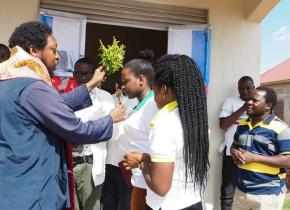
The 2012 OCMC Medical Mission Team to Uganda held six clinics from Jinja in the east to Gulu in the north treating over 3,000 people with a variety of afflictions from parasites to malaria. | |
Thank God for medical professionals! Doctors, nurses, med and pre-med students, moms, and anyone who watches “Grey's Anatomy” or “House” are truly amazing people! My definition of medical professional may be broader than what is generally accepted, but I am comfortable branding any one of the aforementioned people with the title because they all possess infinitely more medical experience than I do, and over the course of a two-week medical mission to Uganda, I witnessed people like these changing the lives of thousands.
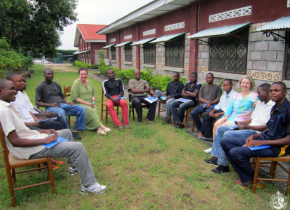
Like all OCMC mission teams, ours began with an orientation at the Mission Center in St. Augustine, Florida. It was clear, even in these first days, that the team possessed the personalities and abilities that make for the most remarkable short-term mission experiences. I have participated on several teams in the past, and this one just seemed to have that buzz of excitement and potential that one has a hard time putting a finger on.
We were a doctor, a nurse practitioner, four nurses, three medical/pre-med students, a child-care provider with a life-long interest in medicine, and me…the guy who passes out at the doctor’s office after receiving a shot. The level of competency on the team, myself excluded, played a huge role in the days that would follow. Medical missions in Uganda, however, are challenging even for the well-trained, and everyone found themselves stretched in some very profound ways as a result.
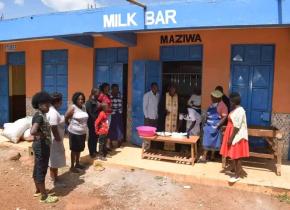
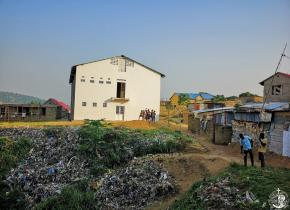
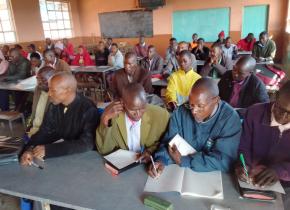
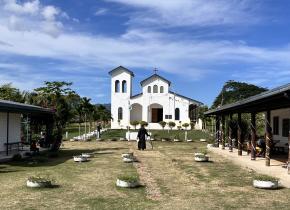
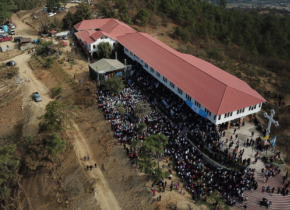
To provide some context, the team was to offer six clinics for people in the east and north of the country. The locations of the clinics were never the same, and they were run on Orthodox parish properties. The buildings available ranged from brick and mortar school classrooms to stick-walled, grass-roofed huts. Each clinic consisted of an area for triage, four to five examination stations, a pharmacy, and a dispensary.
Days were long and would begin early with breakfast. It would take anywhere from an hour to an hour and a half to drive to the clinic in the morning. Stations would be set up and, after morning prayers, the long line of patients would begin making their way through triage. The clinic would run for up to nine hours, and we’d treat 500 to 700 people per day. It would then be back to the hotel, with a stop at the local pharmacy to buy more medicines. Following dinner we’d pre-pack medicines until 11pm or midnight, say our evening prayers, and then try to catch some sleep before waking up at 5am the next morning to start it all over again.
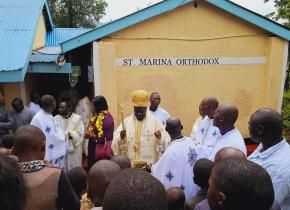
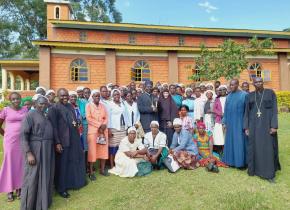
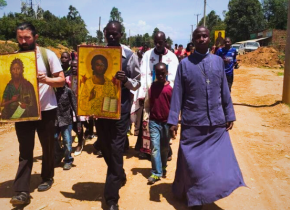
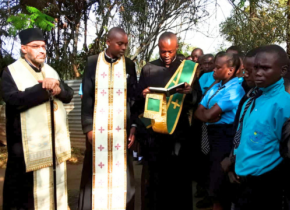
The work, as intense as it was, would have never been possible without the help and support of the Ugandan Orthodox faithful who partnered with the team to offer the clinics. Parish priests would minister to people throughout the day and help with crowd control. Teachers, students, nurses, and doctors would provide care and serve as translators. And, the drivers would shuttle the team around and help load and unload our gear.
As the days flew by, there were many moments when I caught myself marveling at the symphony that was playing out before my very eyes. I was inspired by my team members as they worked themselves to the point of utter exhaustion for people whom they had never met before. I was awed that extra time was taken to comfort people in spite of enormous pressure to get everyone seen. And, I was proud that people remained open and made compromises for the good of something beyond themselves. Most remarkable of all, however, was the fact that faith led all. These men and women who were engaged in the most scientific of pursuits were first and foremost Orthodox Christian, and through these eyes we were blessed with witnessing some truly beautiful stories.
It was one of our first days of clinic. A mother and her four-year-old son sat down on the benches across from Dr. Mike (a team member from San Diego) and his translator. She had brought her son to the clinic because she feared that he was mentally challenged. It turned out that, in fact, the child was deaf. He was unable to speak, but Dr. Mike could tell that the boy was very sharp after spending only a couple of minutes with him.
Though in relatively good health, the team knew that the child would never be able to attend a regular school. Without schooling he faced a future of limited possibilities and even life as an outcast. None of us could pinpoint why, but we asked Fr. Nicholas Bayego, our Ugandan Orthodox liaison and leader, to take down the name and contact information of the family before they left. It just seemed the appropriate thing to do at the time. We’d at least have a name to remember in our prayers.
That evening we went to check into a hotel. The first place we went could not accommodate the team, and the second hotel we visited was booked. Finally, on the outskirts of town, we found rooms at a guest house where we could rest our weary heads. This must have been God’s will, because across the street from this very hotel was a school for deaf children. No one on the team could believe it.
The next day, before heading out for another clinic, Jenny (my wife and fellow team member) took a tour of the school. On our last day in the region, the school administrators visited the team at the hotel and shared what schooling would cost for the little boy we had met.
Thoughts of the little boy and the miraculous circumstances that followed were with the team for the remainder of the journey. More miraculous still was the fact that after all of the clinics, we had a significant amount of team funds left over. Collectively we offered the funds to Fr. Nicholas for the Church to use to send the little boy to school. He smiled, then shared with us the true miracle behind all that was happening.
It turned out that this little boy and his family were not Christian. The Church, through these clinics, was able to care for this family and a relationship formed between them and the Orthodox priest from the area. On our last day in Uganda Fr. Nicholas shared that he had spoken with the mother of the boy and that they were considering becoming Orthodox.
Christian love and kindness had a profound impact on these individual lives. Through them we all began to understand the mission behind the medicine we had come to offer and the important role it can play in new beginnings. Later in the trip, we would also come to understand its place in endings.
Paralyzed from the waist down and nearly too weak to speak, the old man asked if there was anything we could do to ease his pain. After examining him, the healthcare providers on the team determined that the man was probably paralyzed as a result of cancer in his spine. There was nothing we could do; he was in his last days. His family, who had brought him to be seen by the team, quietly picked him up and carried him out of the clinic.
I walked outside a few minutes after they had left to see how many more patients were waiting to be seen so that I could give the healthcare providers an update. A large crowd had gathered in a nearby field. I walked over to see what was going on. The old man was being tied to a rusty bicycle. His family did not have a car or a wheelchair, so they brought him to the clinic using the only means available.
The old man had slipped into unconsciousness. One of the people with him exclaimed, “he is dying!” Fr. Nicholas rushed over. He laid his hands on the man and began to pray as we untied him from the bicycle. Some of the women from the crowd fetched some large banana leaves and laid them on the ground. We set the man down on the leaves, and he opened his eyes. He grabbed my hand. Looking into my eyes, he said that he had pain in his stomach, and asked if there was anything we could give him. We gave him some magnesium tablets, and he smiled.
I felt so helpless and sorry that all we had to offer this man was Tums. Still holding my hand tightly, we gently carried him to the team van and loaded him in. Fr. Nicholas jumped in beside him. I asked Fr. Nicholas where he was going. He looked at me and said somberly, “we are going to take him home.” The van doors closed and I turned away from the crowd quickly to hide the tears that had begun to fall.
As I walked back into the clinic, my sorrow turned to joy. This man was going to die, but he was going to have his family at his side, an Orthodox priest praying for him, and be able to spend his final moments in the safety and comfort of his own home.
Once again, the team was able to see that the comfort provided by medicine alone was limited, but with Faith the love and care we wanted to offer through healthcare could be limitless.
The 2012 OCMC Medical Mission to Uganda was a truly blessed experience where Orthodox faithful from the United States and Uganda worked together to share the Orthodox Faith through a sincere desire to serve and heal others. I will be eternally grateful to all of my fellow team members and to God for the honor and the opportunity to bear witness to the Faith in such an incredible way.